
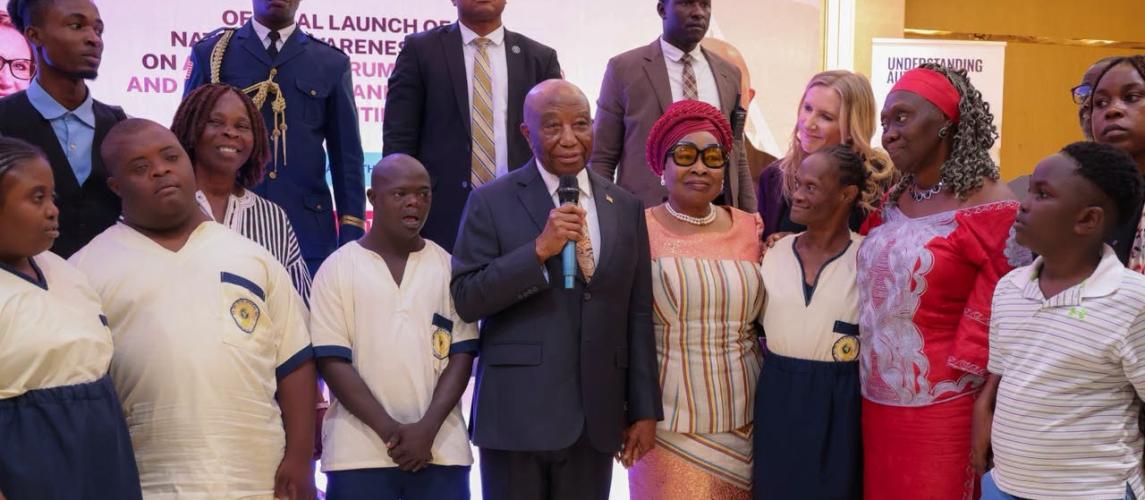
President Boakai, First Lady Launch National Autism and Disability Initiative, Call for Action to End Stigma
The initiative seeks to deepen public understanding of autism and intellectual and developmental disabilities, reduce fear, shame, and blame. Greater awareness will instead promote inclusion and support within families and communities. Through education, advocacy, collaboration, and community engagement, the initiative aims to strengthen support for individuals with these conditions across Liberia.
In his remarks during the launch of the initiative, President Boakai emphasized the Government’s solemn duty to protect Liberia’s most vulnerable citizens and move from awareness to concrete action.
“A nation is measured by how it treats those most vulnerable,” he said, urging Liberians to embrace children with neurodevelopmental conditions as valued members of society with unique purpose and potential.
Frowning at the deep-seated misconceptions, the President lamented how ignorance and stigma have endangered lives and forced families into withdrawal, hiding, and isolation. He stressed that every child with autism deserves love, protection, quality education, and equal opportunity, and that society must adapt to support their development.
President Boakai also underscored the importance of international collaboration, expressing gratitude to the United States-based social service institution, Woods System of Care, for bringing technical expertise, training, and strategic partnership to Liberia.
He commended the Woods’ Delegation that is in Liberia for its commitment to building local capacity while emphasizing that ownership of the initiative ultimately rests with the Liberian people.
The President stressed that awareness must be accompanied by structural reform and dedicated funding, pledging that the Government will strive to implement policy recommendations from the awareness conference to help ensure that every child with developmental differences has the opportunity to contribute meaningfully to Liberia’s future.
For her part, the chief host of the awareness initiative, Liberia’s First Lady Kartumu Yarta Boakai, called for a shift from passive sympathy to organized care and sustained support across Liberia. “When society fails to understand a child, the child is not the failure. The failure is ours,” she said, urging government institutions, schools, and communities to break the silence surrounding neurodevelopmental conditions and uphold every child’s right to dignity, education, and protection.
Highlighting the challenges facing families, the First Lady urged Liberians to confront the stigma and traditional myths that leave children isolated and mothers unfairly blamed. She pointed out that, “Autism is not a curse, it is not witchcraft, and it is not grounds for rejection” emphasizing that awareness must be supported by diagnostic tools, special education services, trained professionals, and inclusive community policies.
Madam Boakai thanked Woods System of Care for translating discussions held abroad into practical efforts to strengthen clinical capacity in Liberia. She stressed that international partnerships must be matched by local action, urging her compatriots that to join the effort in build an integrated support system reaching clinics, schools and homes beyond Monrovia.
The First Lady challenged Liberians to change their attitudes and ensure that the commitments made at the conference lead to lasting action. She pledged to work toward a future in which no child with autism is hidden, abandoned, or forgotten. “Before we build centers, we must break stigma. Before we train professionals, we must retrain society,” she opined.
Woods System of Care President and CEO Tine Hansen-Turton, who headed the delegation from the United States, reaffirmed the Institution’s commitment to a lasting partnership in support of Liberia’s vision. “We are honored to be here today as partners in this important work because we know something profoundly important. Autism is not a curse, disability is not a punishment, and mental illness is not a source of shame,” she said.
CEO Hansen-Turton pledged her Organization’s support for clinical training, a medical fellowship and international knowledge exchange to strengthen sustainable, Liberian-led care throughout individuals’ lives.
She explained that autism and intellectual disabilities are neurodevelopmental conditions with biological foundations and that care systems must respond to a wide range of individual needs—from people who do not use speech and require round-the-clock assistance.
The Woods System of Care Team announced that healthcare workers and local advocates are already receiving specialized training in Liberia. The effort aims to establish a model that can expand nationwide, equipping local medical professionals to serve as long-term advocates and trainers. “We do not try to fix the person to fit into our system. We need to fix our system to meet the needs of the individual,” Hansen-Turton said.
The Ministers of Health, Dr. Louise Mapleh Kpoto; Gender, Children and Social Protection, Gbeme Horace-Kollie; Education, Dr. Jarso Maley Jallah; as well as National Civil Society Council Leader W. Lawrence Yealue II, welcomed the initiative and pledged to play their respective parts in translating the conference’s recommendations into concrete national action.
They called for budgetary support for service providers and institutions supporting people with developmental disabilities, stronger efforts to combat harmful stigma, and action on inclusive education policies and pending disability legislation.
